
Trail Making Test
Connect numbers in Part A and alternate numbers and letters in Part B. Play free online, or print worksheets and save as PDF.
Connect 1–25 in order.
🎯 How to Play
- Choose A & B for both parts, or select Part A or Part B. Try a short practice first if needed.
- Part A: connect 1–25 in order. Part B: connect 1–A–2–B and continue to 12–L–13. Click or tap each circle; you do not need to drag.
- The timer starts when the board appears. A wrong circle does not advance the path, and the timer keeps running. Changing the board size or leaving the page interrupts the current part.
A & B Leaderboard
Practice benefits & everyday uses
Visual search & attention
Find the next target among scattered circles. Visual search is also what you use to locate an item in a list, a number in a spreadsheet or an option in a menu.
Cognitive flexibility
Switch between number and letter rules in Part B. Cognitive flexibility is also useful when moving between work steps, applying a changed instruction or returning to a task after an interruption.
Working memory & sequencing
Remember where you are in both sequences and what comes next. Keeping track of progress also matters when following a recipe, assembling something or completing a series of instructions.
The Science Behind the Game
The science behind Trail Making Test practice
The Trail Making Test (TMT) involves visual search, attention and sequencing. Part B also draws on working memory to track two sequences and cognitive flexibility to switch between numbers and letters.
Each connection follows a simple cycle: find the target, act, then update the next step. Try the same deliberate approach when working through a checklist or a set of instructions. In the game, aim for fewer mistakes as well as a faster time.
Screen size, input method and the random layout can affect your time. When comparing rounds, use the same device and consider both completion time and errors.
FAQ
Related Games
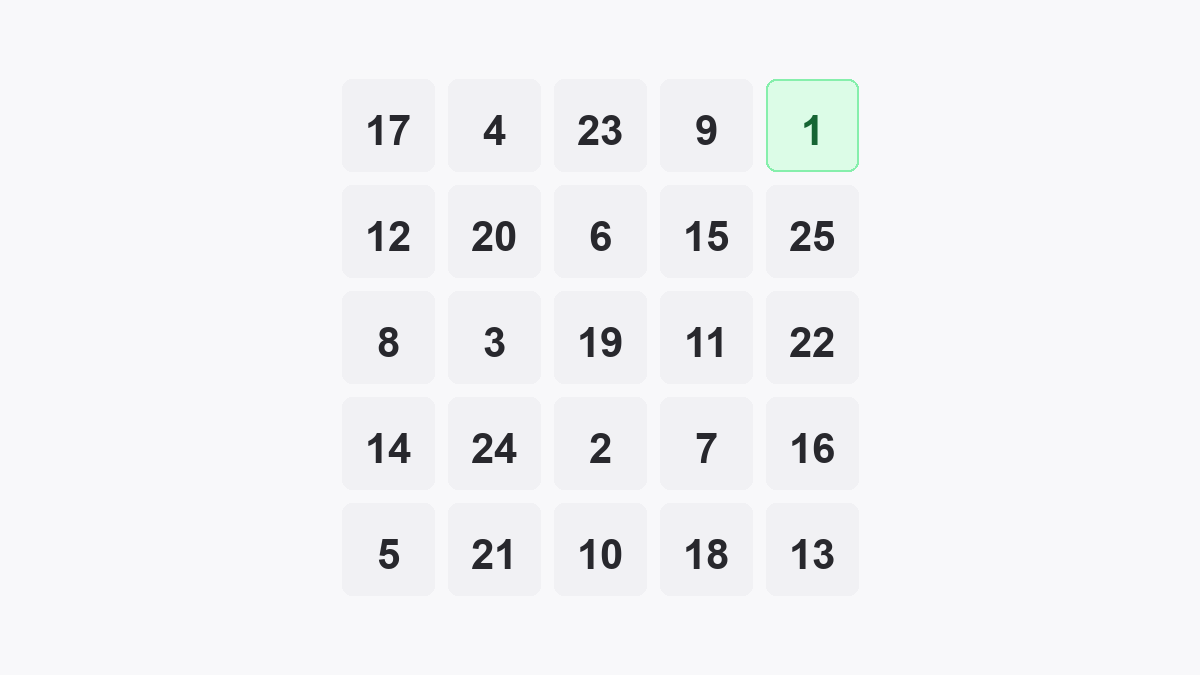 Selective Attention
Schulte Table
Practice a timed 5×5 number-search task. Find 1–25 in order, track completion time and mistakes, and compare repeated attempts under the same conditions.
 Selective Attention
Stroop Effect Test
Take a free Stroop effect test online by naming the ink color instead of the word. Train selective attention, inhibition control, and conflict resolution while tracking your reaction time.
 Working Memory
Digit Span Test
Recall digits forward or backward and review your longest successful span.